Making Whiteness the Culture of Segregation Book Review
Jim Crow laws were country and local laws that enforced racial segregation in the Southern United States.[1] Other areas in the United States were as well afflicted by formal and informal policies of segregation,[ii] but many states outside the South had adopted laws, beginning in the late nineteenth century, that variously banned discrimination in public accommodations and voting.[iii] Southern laws were enacted in the late 19th and early on 20th centuries by white Southern Democrat-dominated land legislatures to disenfranchise and remove political and economic gains made by black people during the Reconstruction period.[four] Jim Crow laws were enforced until 1965.[5]
In practice, Jim Crow laws mandated racial segregation in all public facilities in us of the former Confederate States of America and in some others, commencement in the 1870s. Jim Crow laws were upheld in 1896 in the instance of Plessy vs. Ferguson, in which the U.S. Supreme Courtroom laid out its "separate but equal" legal doctrine for facilities for African Americans. Moreover, public teaching had essentially been segregated since its establishment in nigh of the Southward subsequently the Ceremonious War in 1861–65.
Although in theory the "equal" segregation doctrine was extended to public facilities and transportation also, facilities for African Americans were consistently inferior and underfunded compared to facilities for white Americans; sometimes, there were no facilities for the black community at all.[6] [7] Far from equality, as a body of law, Jim Crow institutionalized economical, educational, political and social disadvantages and second class citizenship for most African Americans living in the Us.[half-dozen] [7] [viii] Afterward the National Association for the Advancement of Colored People (NAACP) was founded in 1909, it helped lead a sustained public protest and legal assault on Jim Crow, and the so-called "separate but equal" doctrine.
In 1954, segregation of public schools (land-sponsored) was declared unconstitutional by the U.Southward. Supreme Court under Principal Justice Earl Warren in the landmark example Brown v. Board of Education.[9] [10] [11] In some states, it took many years to implement this decision, while the Warren Courtroom continued to rule against the Jim Crow laws in other cases such as Heart of Atlanta Cabin, Inc. 5. United states (1964).[12] Generally, the remaining Jim Crow laws were overruled past the Civil Rights Act of 1964 and the Voting Rights Act of 1965.
Etymology
The phrase "Jim Crow Law" can be institute every bit early equally 1884 in a newspaper article summarizing congressional debate.[xiii] The term appears in 1892 in the title of a New York Times commodity nigh Louisiana requiring segregated railroad cars.[14] [15] The origin of the phrase "Jim Crow" has often been attributed to "Leap Jim Crow", a song-and-trip the light fantastic caricature of black people performed by white actor Thomas D. Rice in blackface, which kickoff surfaced in 1828 and was used to satirize Andrew Jackson'southward populist policies. As a outcome of Rice'south fame, "Jim Crow" by 1838 had get a pejorative expression significant "Negro". When southern legislatures passed laws of racial segregation directed confronting black people at the end of the 19th century, these statutes became known as Jim Crow laws.[14]
Origins
In January 1865, an amendment to the Constitution to abolish slavery in the Usa was proposed by Congress, and on December 18, 1865, it was ratified as the Thirteenth Amendment formally abolishing slavery.[16]

Cover of an early on edition of "Jump Jim Crow" sail music (c. 1832)

Freedmen voting in New Orleans, 1867
During the Reconstruction catamenia of 1865–1877, federal laws provided civil rights protections in the U.Southward. Southward for freedmen, African Americans who had formerly been slaves, and the minority of blackness people who had been free earlier the war. In the 1870s, Democrats gradually regained power in the Southern legislatures,[17] after having used insurgent paramilitary groups, such as the White League and the Ruby-red Shirts, to disrupt Republican organizing, run Republican officeholders out of town, and intimidate black people to suppress their voting.[18] Extensive voter fraud was too used. In 1 instance, an outright coup or insurrection in coastal Due north Carolina led to the fierce removal of democratically elected Republican party executive and representative officials, who were either hunted down or hounded out. Gubernatorial elections were close and had been disputed in Louisiana for years, with increasing violence confronting blackness people during campaigns from 1868 onward.
In 1877, a compromise to gain Southern support in the presidential election (a corrupt bargain) resulted in the authorities's withdrawing the last of the federal troops from the South. White Democrats had regained political power in every Southern country.[19] These Southern, white, "Redeemer" governments legislated Jim Crow laws, officially segregating black people from the white population. Jim Crow laws were a manifestation of authoritarian rule specifically directed at one racial group.[xx]
Blacks were still elected to local offices throughout the 1880s in local areas with large black populations, but their voting was suppressed for state and national elections. States passed laws to make voter registration and electoral rules more than restrictive, with the result that political participation by most black people and many poor white people began to subtract.[21] [22] Between 1890 and 1910, 10 of the eleven former Confederate states, starting with Mississippi, passed new constitutions or amendments that effectively disenfranchised most black people and tens of thousands of poor white people through a combination of poll taxes, literacy and comprehension tests, and residency and record-keeping requirements.[21] [22] Granddad clauses temporarily permitted some illiterate white people to vote but gave no relief to well-nigh black people.
Voter turnout dropped drastically through the South as a result of such measures. In Louisiana, by 1900, blackness voters were reduced to 5,320 on the rolls, although they comprised the majority of the country's population. By 1910, only 730 black people were registered, less than 0.v% of eligible black men. "In 27 of the state's 60 parishes, not a unmarried black voter was registered whatsoever longer; in 9 more parishes, just one black voter was."[23] The cumulative outcome in N Carolina meant that blackness voters were completely eliminated from voter rolls during the menstruum from 1896 to 1904. The growth of their thriving centre class was slowed. In North Carolina and other Southern states, black people suffered from being made invisible in the political system: "[West]ithin a decade of disfranchisement, the white supremacy entrada had erased the image of the black middle course from the minds of white North Carolinians."[23] In Alabama tens of thousands of poor whites were likewise disenfranchised, although initially legislators had promised them they would not be affected adversely by the new restrictions.[24]
Those who could non vote were non eligible to serve on juries and could not run for local offices. They finer disappeared from political life, as they could non influence the state legislatures, and their interests were disregarded. While public schools had been established by Reconstruction legislatures for the first time in almost Southern states, those for black children were consistently underfunded compared to schools for white children, fifty-fifty when considered within the strained finances of the postwar South where the decreasing price of cotton kept the agricultural economy at a low.[25]
Similar schools, public libraries for black people were underfunded, if they existed at all, and they were often stocked with secondhand books and other resources.[vii] [26] These facilities were non introduced for African Americans in the South until the first decade of the 20th century.[27] Throughout the Jim Crow era, libraries were only available sporadically.[28] Prior to the 20th century, most libraries established for African Americans were school-library combinations.[28] Many public libraries for both European-American and African-American patrons in this menstruum were founded as the result of middle-class activism aided past matching grants from the Carnegie Foundation.[28]
In some cases, progressive measures intended to reduce election fraud, such as the Eight Box Police in Southward Carolina, acted against black and white voters who were illiterate, as they could not follow the directions.[29] While the separation of African Americans from the white general population was condign legalized and formalized during the Progressive Era (1890s–1920s), it was as well becoming customary. For instance, even in cases in which Jim Crow laws did non expressly forbid black people to participate in sports or recreation, a segregated civilisation had become common.[14]
In the Jim Crow context, the presidential election of 1912 was steeply slanted confronting the interests of African Americans.[30] Almost black people notwithstanding lived in the Due south, where they had been finer disfranchised, then they could not vote at all. While poll taxes and literacy requirements banned many poor or illiterate Americans from voting, these stipulations ofttimes had loopholes that exempted European Americans from meeting the requirements. In Oklahoma, for instance, anyone qualified to vote before 1866, or related to someone qualified to vote before 1866 (a kind of "grandfather clause"), was exempted from the literacy requirement; but the only persons who had the franchise before that year were white, or European-American males. European Americans were finer exempted from the literacy testing, whereas black Americans were effectively singled out by the law.[31]
Woodrow Wilson was a Democrat elected from New Jersey, but he was born and raised in the South, and was the first Southern-born president of the mail-Ceremonious War period. He appointed Southerners to his Cabinet. Some quickly began to printing for segregated workplaces, although the city of Washington, D.C., and federal offices had been integrated since later the Civil State of war. In 1913, for case, Secretary of the Treasury William Gibbs McAdoo – an appointee of the President – was heard to express his opinion of black and white women working together in ane authorities part: "I feel sure that this must go against the grain of the white women. Is there any reason why the white women should non take only white women working across from them on the machines?"[32]
The Wilson administration introduced segregation in federal offices, despite much protest from African-American leaders and white progressive groups in the north and midwest.[33] He appointed segregationist Southern politicians because of his own firm belief that racial segregation was in the all-time interest of blackness and European Americans alike.[34] At the Neat Reunion of 1913 at Gettysburg, Wilson addressed the crowd on July 4, the semi-centennial of Abraham Lincoln's declaration that "all men are created equal":
How consummate the union has become and how dearest to all of us, how unquestioned, how benign and majestic, as state later on land has been added to this, our great family of gratuitous men![35]
In sharp contrast to Wilson, a Washington Bee editorial wondered if the "reunion" of 1913 was a reunion of those who fought for "the extinction of slavery" or a reunion of those who fought to "perpetuate slavery and who are at present employing every artifice and argument known to cant" to nowadays emancipation as a failed venture.[35] Historian David W. Blight notes that the "Peace Jubilee" at which Wilson presided at Gettysburg in 1913 "was a Jim Crow reunion, and white supremacy might be said to have been the silent, invisible master of ceremonies".[35]
In Texas, several towns adopted residential segregation laws between 1910 and the 1920s. Legal strictures chosen for segregated water fountains and restrooms.[35] The exclusion of African Americans also plant support in the Republican lily-white move.[36]
Historical development
Early attempts to suspension Jim Crow

The Civil Rights Act of 1875, introduced by Charles Sumner and Benjamin F. Butler, stipulated a guarantee that everyone, regardless of race, colour, or previous condition of servitude, was entitled to the aforementioned treatment in public accommodations, such every bit inns, public transportation, theaters, and other places of recreation. This Act had little effect in exercise.[37] An 1883 Supreme Court determination ruled that the act was unconstitutional in some respects, proverb Congress was non afforded command over private persons or corporations. With white southern Democrats forming a solid voting bloc in Congress, due to having outsize power from keeping seats apportioned for the total population in the Due south (although hundreds of thousands had been disenfranchised), Congress did not pass another civil rights police until 1957.[38]
In 1887, Rev. Due west. H. Heard lodged a complaint with the Interstate Commerce Commission confronting the Georgia Railroad visitor for bigotry, citing its provision of different cars for white and black/colored passengers. The visitor successfully appealed for relief on the grounds it offered "split up only equal" accommodation.[39]
In 1890, Louisiana passed a law requiring separate accommodations for colored and white passengers on railroads. Louisiana law distinguished betwixt "white", "blackness" and "colored" (that is, people of mixed European and African ancestry). The law had already specified that black people could not ride with white people, simply colored people could ride with white people before 1890. A group of concerned blackness, colored and white citizens in New Orleans formed an association dedicated to rescinding the law. The group persuaded Homer Plessy to examination it; he was a homo of color who was of fair complexion and 1-eighth "Negro" in beginnings.[40]
In 1892, Plessy bought a outset-course ticket from New Orleans on the East Louisiana Railway. Once he had boarded the train, he informed the railroad train conductor of his racial lineage and took a seat in the whites-only machine. He was directed to leave that car and sit instead in the "coloreds only" motorcar. Plessy refused and was immediately arrested. The Citizens Commission of New Orleans fought the instance all the way to the United states Supreme Court. They lost in Plessy v. Ferguson (1896), in which the Court ruled that "dissever but equal" facilities were constitutional. The finding contributed to 58 more years of legalized discrimination against blackness and colored people in the United States.[40]
In 1908 Congress defeated an attempt to introduce segregated streetcars into the capital.[41]
Racism in the Usa and defenses of Jim Crow

1904 caricature of "White" and "Jim Crow" rail cars by John T. McCutcheon. Despite Jim Crow's legal pretense that the races be "separate but equal" under the law, non-whites were given junior facilities and handling.[42]
White Southerners encountered problems in learning free labor management after the finish of slavery, and they resented African Americans, who represented the Confederacy's Civil War defeat: "With white supremacy being challenged throughout the South, many whites sought to protect their quondam status by threatening African Americans who exercised their new rights."[43] White Southerners used their power to segregate public spaces and facilities in law and reestablish social dominance over blackness people in the South.
One rationale for the systematic exclusion of African Americans from southern public society was that it was for their own protection. An early 20th-century scholar suggested that allowing black people to attend white schools would mean "constantly subjecting them to adverse feeling and opinion", which might pb to "a morbid race consciousness".[44] This perspective took anti-black sentiment for granted, because discrimination was widespread in the Due south after slavery became a racial caste organization.
Justifications for white supremacy were provided by scientific racism and negative stereotypes of African Americans. Social segregation, from housing to laws against interracial chess games, was justified as a way to prevent blackness men from having sex with white women and in particular the rapacious Blackness Cadet stereotype.[45]
Globe State of war 2 and post-state of war era
In 1944, Associate Justice Frank Murphy introduced the discussion "racism" into the lexicon of U.Due south. Supreme Court opinions in Korematsu v. United States, 323 U.S. 214 (1944).[46] In his dissenting opinion, Murphy stated that by upholding the forced relocation of Japanese Americans during Globe War Ii, the Court was sinking into "the ugly abyss of racism". This was the offset time that "racism" was used in Supreme Court opinion (Irish potato used it twice in a concurring opinion in Steele five Louisville & Nashville Railway Co 323 192 (1944) issued that twenty-four hours).[47] Murphy used the word in 5 split up opinions, but after he left the court, "racism" was not used again in an opinion for two decades. It next appeared in the landmark conclusion of Loving v. Virginia, 388 U.South. ane (1967).
Numerous boycotts and demonstrations confronting segregation had occurred throughout the 1930s and 1940s. The NAACP had been engaged in a serial of litigation cases since the early on 20th century in efforts to gainsay laws that disenfranchised blackness voters across the S. Some of the early on demonstrations achieved positive results, strengthening political activism, specially in the mail service-World War II years. Black veterans were impatient with social oppression afterward having fought for the United states and freedom across the world. In 1947 K. Leroy Irvis of Pittsburgh's Urban League, for instance, led a demonstration confronting employment discrimination by the metropolis'due south department stores. It was the beginning of his own influential political career.[48]
After World War Ii, people of colour increasingly challenged segregation, equally they believed they had more than earned the right to be treated as total citizens because of their military machine service and sacrifices. The Civil Rights Motion was energized past a number of flashpoints, including the 1946 police beating and blinding of World State of war II veteran Isaac Woodard while he was in U.South. Regular army compatible. In 1948 President Harry South. Truman issued Executive Lodge 9981, desegregating the armed services.[49]
Every bit the Civil Rights Motility gained momentum and used federal courts to assail Jim Crow statutes, the white-dominated governments of many of the southern states countered by passing culling forms of restrictions.[ citation needed ]
Decline and removal
Historian William Chafe has explored the defensive techniques adult inside the African-American community to avert the worst features of Jim Crow as expressed in the legal organization, unbalanced economic power, and intimidation and psychological force per unit area. Chafe says "protective socialization by blackness people themselves" was created inside the customs in order to accommodate white-imposed sanctions while subtly encouraging challenges to those sanctions. Known as "walking the tightrope," such efforts at bringing about change were only slightly constructive before the 1920s.
However, this did build the foundation for after generations to advance racial equality and de-segregation. Chafe argued that the places essential for change to begin were institutions, specially blackness churches, which functioned equally centers for customs-edifice and discussion of politics. Additionally, some all-blackness communities, such as Mound Bayou, Mississippi and Ruthville, Virginia served every bit sources of pride and inspiration for black society as a whole. Over time, pushback and open up defiance of the oppressive existing laws grew, until it reached a humid point in the aggressive, large-scale activism of the 1950s civil rights move.[50]
Chocolate-brown v. Lath of Education

The NAACP Legal Defense Committee (a grouping that became independent of the NAACP) – and its lawyer, Thurgood Marshall – brought the landmark case Brown v. Lath of Teaching of Topeka, 347 U.Due south. 483 (1954) before the U.South. Supreme Courtroom nether Chief Justice Earl Warren.[9] [10] [xi] In its pivotal 1954 decision, the Warren Court unanimously (9–0) overturned the 1896 Plessy decision.[10] The Supreme Court constitute that legally mandated (de jure) public school segregation was unconstitutional. The conclusion had far-reaching social ramifications.[51]
Integrating collegiate sports
Racial integration of all-white collegiate sports teams was high on the Southern agenda in the 1950s and 1960s. Involved were issues of equality, racism, and the alumni need for the peak players needed to win high-profile games. The Atlantic Coast Conference (ACC) of flagship country universities in the Southeast took the pb. First they started to schedule integrated teams from the North. Finally, ACC schools – typically under pressure from boosters and ceremonious rights groups – integrated their teams.[52] With an alumni base that dominated local and state politics, society and business, the ACC schools were successful in their endeavour – as Pamela Grundy argues, they had learned how to win:
- The widespread admiration that able-bodied ability inspired would help transform athletic fields from grounds of symbolic play to forces for social change, places where a broad range of citizens could publicly and at times effectively challenge the assumptions that bandage them as unworthy of full participation in U.Due south. society. While athletic successes would not rid society of prejudice or stereotype – black athletes would continue to confront racial slurs...[minority star players demonstrated] the field of study, intelligence, and poise to contend for position or influence in every arena of national life.[53]
Public arena
In 1955, Rosa Parks refused to give up her seat on a city jitney to a white homo in Montgomery, Alabama. This was not the first time this happened – for example, Parks was inspired by 15-twelvemonth-old Claudette Colvin doing the same matter nine months earlier[54] – but the Parks deed of civil disobedience was called, symbolically, every bit an important goad in the growth of the Ceremonious Rights Movement; activists congenital the Montgomery bus boycott around it, which lasted more than a year and resulted in desegregation of the privately run buses in the city. Civil rights protests and actions, together with legal challenges, resulted in a series of legislative and courtroom decisions which contributed to undermining the Jim Crow system.[55]
Terminate of legal segregation

The decisive activity ending segregation came when Congress in bipartisan style overcame Southern filibusters to pass the Civil Rights Deed of 1964 and the Voting Rights Act of 1965. A complex interaction of factors came together unexpectedly in the period 1954–1965 to make the momentous changes possible. The Supreme Court had taken the offset initiative in Brown 5. Board of Education (1954), declaring segregation of public schools unconstitutional. Enforcement was rapid in the N and border states, simply was deliberately stopped in the Southward by the movement chosen Massive Resistance, sponsored by rural segregationists who largely controlled the country legislatures. Southern liberals, who counseled moderation, were shouted down by both sides and had limited affect. Much more significant was the Civil Rights Movement, especially the Southern Christian Leadership Briefing (SCLC) headed past Martin Luther King, Jr. It largely displaced the old, much more than moderate NAACP in taking leadership roles. King organized massive demonstrations, that seized massive media attention in an era when network television news was an innovative and universally watched phenomenon.[56]
SCLC, educatee activists and smaller local organizations staged demonstrations beyond the Due south. National attention focused on Birmingham, Alabama, where protesters deliberately provoked Bull Connor and his police forces by using immature teenagers as demonstrators – and Connor arrested 900 on one day solitary. The adjacent day Connor unleashed billy clubs, police force dogs, and loftier-pressure water hoses to disperse and punish the immature demonstrators with a brutality that horrified the nation. It was very bad for business, and for the image of a modernizing progressive urban Due south. President John F. Kennedy, who had been calling for moderation, threatened to use federal troops to restore order in Birmingham. The event in Birmingham was compromise by which the new mayor opened the library, golf courses, and other metropolis facilities to both races, against the backdrop of church bombings and assassinations.[57]
In summertime 1963, there were 800 demonstrations in 200 southern cities and towns, with over 100,000 participants, and 15,000 arrests. In Alabama in June 1963 Governor George Wallace escalated the crisis by defying court orders to admit the get-go 2 blackness students to the University of Alabama.[58] Kennedy responded by sending Congress a comprehensive civil rights bill, and ordered Chaser General Robert Kennedy to file federal lawsuits confronting segregated schools, and to deny funds for discriminatory programs. Doctor Male monarch launched a massive march on Washington in Baronial 1963, bringing out 200,000 demonstrators in front end of the Lincoln Memorial, the largest political assembly in the nation's history. The Kennedy administration now gave full-fledged back up to the ceremonious rights movement, but powerful southern congressmen blocked any legislation.[59]
After Kennedy was assassinated President Lyndon Johnson called for firsthand passage of Kennedy civil rights legislation as a memorial to the martyred president. Johnson formed a coalition with Northern Republicans that led to passage in the Firm, and with the help of Republican Senate leader Everett Dirksen with passage in the Senate early in 1964. For the showtime fourth dimension in history, the southern delay was broken and The Senate finally passed its version on June 19 by vote of 73 to 27.[threescore]
The Civil Rights Human activity of 1964 was the most powerful affirmation of equal rights ever made by Congress. Information technology guaranteed access to public accommodations such every bit restaurants and places of amusement, authorized the Justice Department to bring suits to desegregate facilities in schools, gave new powers to the Civil Rights Commission; and immune federal funds to exist cut off in cases of discrimination. Furthermore, racial, religious and gender discrimination was outlawed for businesses with 25 or more than employees, as well every bit flat houses. The South resisted until the last moment, but as soon equally the new law was signed by President Johnson on July 2, 1964, it was widely accepted across the nation. At that place was simply a scattering of diehard opposition, typified by restaurant owner Lester Maddox in Georgia.[61] [62] [63] [64]
In January 1964, President Lyndon Johnson met with civil rights leaders. On Jan 8, during his first State of the Union accost, Johnson asked Congress to "let this session of Congress be known every bit the session which did more for civil rights than the final hundred sessions combined." On June 21, civil rights workers Michael Schwerner, Andrew Goodman, and James Chaney disappeared in Neshoba County, Mississippi, where they were volunteering in the registration of African-American voters as part of the Freedom Summertime project. The disappearance of the iii activists captured national attention and the ensuing outrage was used by Johnson and civil rights activists to build a coalition of northern and western Democrats and Republicans and push Congress to pass the Civil Rights Deed of 1964.[65]
On July 2, 1964, Johnson signed the historic Civil Rights Act of 1964.[65] [66] It invoked the Commerce Clause[65] to outlaw discrimination in public accommodations (privately owned restaurants, hotels, and stores, and in private schools and workplaces). This use of the Commerce Clause was upheld by the Warren Court in the landmark case Middle of Atlanta Motel v. Us 379 US 241 (1964).[67]
By 1965, efforts to break the grip of state disenfranchisement by education for voter registration in southern counties had been underway for some time, only had achieved only modest success overall. In some areas of the Deep South, white resistance made these efforts virtually entirely ineffectual. The murder of the three voting-rights activists in Mississippi in 1964 and the state'due south refusal to prosecute the murderers, along with numerous other acts of violence and terrorism against black people, had gained national attention. Finally, the unprovoked set on on March 7, 1965, past county and state troopers on peaceful Alabama marchers crossing the Edmund Pettus Bridge en route from Selma to the state majuscule of Montgomery, persuaded the President and Congress to overcome Southern legislators' resistance to effective voting rights enforcement legislation. President Johnson issued a call for a potent voting rights law and hearings shortly began on the beak that would become the Voting Rights Act.[68]
The Voting Rights Act of 1965 ended legally sanctioned state barriers to voting for all federal, land and local elections. It also provided for federal oversight and monitoring of counties with historically low minority voter turnout. Years of enforcement take been needed to overcome resistance, and boosted legal challenges have been made in the courts to ensure the ability of voters to elect candidates of their choice. For instance, many cities and counties introduced at-large election of quango members, which resulted in many cases of diluting minority votes and preventing election of minority-supported candidates.[69]
In 2013, the Roberts Court removed the requirement established past the Voting Rights Act that Southern states needed Federal approval for changes in voting policies. Several states immediately made changes in their laws restricting voting access.[70]
Influence and aftermath
African-American life
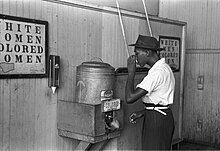
An African-American homo drinking at a "colored" drinking fountain in a streetcar final in Oklahoma City, Oklahoma, 1939
The Jim Crow laws and the high rate of lynchings in the South were major factors that led to the Swell Migration during the first one-half of the 20th century. Because opportunities were so limited in the South, African Americans moved in great numbers to cities in Northeastern, Midwestern, and Western states to seek better lives.
Despite the hardship and prejudice of the Jim Crow era, several black entertainers and literary figures gained broad popularity with white audiences in the early 20th century. They included influential tap dancers Bill "Bojangles" Robinson and the Nicholas Brothers, jazz musicians such as Louis Armstrong, Duke Ellington and Count Basie, and the extra Hattie McDaniel. In 1939 McDaniel was the first black person to receive an University Award when she won the Best Supporting Actress Oscar for her functioning every bit Mammy in Gone with the Air current.[71]
African-American athletes faced much discrimination during the Jim Crow period. White opposition led to their exclusion from most organized sporting competitions. The boxers Jack Johnson and Joe Louis (both of whom became world heavyweight battle champions) and track and field athlete Jesse Owens (who won four aureate medals at the 1936 Summer Olympics in Berlin) earned fame during this era. In baseball, a color line instituted in the 1880s had informally barred blackness people from playing in the major leagues, leading to the development of the Negro leagues, which featured many fine players. A major quantum occurred in 1947, when Jackie Robinson was hired as the first African American to play in Major League Baseball; he permanently broke the colour bar. Baseball teams continued to integrate in the following years, leading to the total participation of black baseball players in the Major Leagues in the 1960s.[ commendation needed ]
Interracial marriage
Although sometimes counted amongst "Jim Crow laws" of the Southward, statutes such as anti-miscegenation laws were also passed by other states. Anti-miscegenation laws were non repealed by the Ceremonious Rights Act of 1964, only were alleged unconstitutional past the U.Due south. Supreme Courtroom (the Warren Court) in a unanimous ruling Loving five. Virginia (1967).[65] [72] [73] Primary Justice Earl Warren wrote in the court opinion that "the freedom to marry, or not ally, a person of another race resides with the private, and cannot be infringed by the State."[73]
Jury trials
The Sixth Amendment to the United states of america Constitution grants criminal defendants the right to a trial by a jury of their peers. While federal constabulary required that convictions could only be granted past a unanimous jury for federal crimes, states were costless to set their ain jury requirements. All merely 2 states, Oregon and Louisiana, opted for unanimous juries for conviction. Oregon and Louisiana, yet, allowed juries of at least x–2 to determine a criminal confidence. Louisiana'southward police was amended in 2018 to require a unanimous jury for criminal convictions, effective in 2019. Prior to that amendment, the law had been seen as a remnant of Jim Crow laws, because it immune minority voices on a jury to be marginalized. In 2020, the Supreme Courtroom found, in Ramos v. Louisiana, that unanimous jury votes are required for criminal convictions at state levels, thereby nullifying Oregon's remaining law, and overturning previous cases in Louisiana.[74]
Later court cases
In 1971, the U.S. Supreme Courtroom (the Burger Court), in Swann 5. Charlotte-Mecklenburg Lath of Pedagogy, upheld desegregation busing of students to achieve integration.
Interpretation of the Constitution and its awarding to minority rights continues to exist controversial equally Courtroom membership changes. Observers such as Ian F. Lopez believe that in the 2000s, the Supreme Court has go more protective of the status quo.[75]
International
There is testify that the government of Nazi Germany took inspiration from the Jim Crow laws when writing the Nuremberg Laws.[76]
Remembrance
Ferris Land University in Large Rapids, Michigan, houses the Jim Crow Museum of Racist Memorabilia, an extensive drove of everyday items that promoted racial segregation or presented racial stereotypes of African Americans, for the purpose of bookish research and didactics about their cultural influence.[77]
Come across also
- Anti-miscegenation laws
- Apartheid
- Black Codes in the United States
- Disenfranchisement after the Reconstruction era
- Group Areas Act
- Jim Crow economy
- List of Jim Crow police examples by state
- Lynching
- Mass racial violence in the United States
- Penal labor
- Racial segregation in the United states
- Racism in the United States
- Second-class citizen
- Sundown boondocks
- Timeline of the civil rights motility
- The New Jim Crow
Footnotes
- ^ Fremon, David (2000). The Jim Crow Laws and Racism in American History . Enslow. ISBN0766012972.
- ^ Bubar, Joe. (March 9, 2020). The Jim Crow North - Upfront Mag - Scholastic, =Retrieved June 7, 2021.
- ^ Discrimination in Access to Public Places: A Survey of State and Federal Accommodations Laws, 7 N.Y.U. Rev.50. & Soc.Alter 215, 238 (1978)
- ^ Bruce Bartlett (2008). Incorrect on Race: The Autonomous Party's Buried By. St. Martin's Press. pp. 24–. ISBN978-0-230-61138-two.
- ^ Elizabeth Schmermund (2016). Reading and Interpreting the Works of Harper Lee. Enslow Publishing, LLC. pp. 27–. ISBN978-0-7660-7914-four.
- ^ a b Perdue, Theda (October 28, 2011). "Legacy of Jim Crow for Southern Native Americans". C-SPAN . Retrieved November 27, 2018.
- ^ a b c Lowery, Malinda Maynor (2010). Lumbee Indians in the Jim Crow South: Race, Identity, and the Making of a Nation. Univ of North Carolina Press. pp. 0–339. ISBN9780807833681 . Retrieved November 27, 2018.
- ^ Wolfley, Jeanette (1990). "Jim Crow, Indian Style: The Disenfranchisement of Native Americans" (PDF). Indian Police force Review. sixteen (1): 167–202. doi:10.2307/20068694. hdl:1903/22633. JSTOR 20068694. Archived from the original (PDF) on April 12, 2019. Retrieved November 27, 2018.
- ^ a b "Brown v. Board of Didactics". Landmark Supreme Court Cases . Retrieved September 29, 2019.
- ^ a b c "Dark-brown v. Lath of Education of Topeka". Oyez . Retrieved September 29, 2019.
- ^ a b "Two Landmark Decisions in the Fight for Equality and Justice". National Museum of African American History and Culture. October 11, 2017. Retrieved September 29, 2019.
- ^ "Heart of Atlanta Motel, Inc. 5. The states". Oyez . Retrieved September 29, 2019.
- ^ "Congressional". Sioux City Periodical. December 18, 1884. p. 2.
- ^ a b c Woodward, C. Vann and McFeely, William Southward. (2001), The Foreign Career of Jim Crow. p. vii
- ^ "Louisiana's 'Jim Crow' Constabulary Valid". The New York Times. New York. December 21, 1892. p. 1. ISSN 0362-4331. Retrieved February six, 2011.
New Orleans, Dec 20. – The Supreme Courtroom yesterday alleged constitutional the law passed two years ago and known equally the 'Jim Crow' law, making it compulsory on railroads to provide split cars for black people.
- ^ Gerald D. Jaynes (2005). Encyclopedia of African American Gild. Sage. pp. 864–. ISBN978-0-7619-2764-8.
- ^ Melissa Milewski (2017). Litigating Beyond the Color Line: Civil Cases Betwixt Black and White Southerners from the End of Slavery to Civil Rights. Oxford University Press. pp. 47–. ISBN978-0-19-024919-9.
- ^ Michael Perman (2009). Pursuit of Unity: A Political History of the American South. Univ of North Carolina Press. pp. 138–. ISBN978-0-8078-3324-7.
- ^ Woodward, C. Vann, and McFeely, William S. The Strange Career of Jim Crow. 2001, p. half-dozen.
- ^ Parker, Christopher Sebastian; Towler, Christopher C. (May xi, 2019). "Race and Authoritarianism in American Politics". Almanac Review of Political Science. 22 (1): 503–519. doi:10.1146/annurev-polisci-050317-064519. ISSN 1094-2939.
- ^ a b Michael Perman.Struggle for Mastery: Disfranchisement in the South, 1888–1908. Chapel Colina: Academy of North Carolina Press, 2001, Introduction.
- ^ a b J. Morgan Kousser.The Shaping of Southern Politics: Suffrage Brake and the Establishment of the One-Party South, New Haven: Yale Academy Press, 1974.
- ^ a b Richard H. Pildes, "Democracy, Anti-Democracy, and the Catechism", 2000, pp. 12, 27. Retrieved March 10, 2008.
- ^ Glenn Feldman, The Disfranchisement Myth: Poor Whites and Suffrage Brake in Alabama, Athens: University of Georgia Press, 2004, pp. 135–36.
- ^ Reese, Westward. (2010). History, Education, and the Schools. Springer. p. 145. ISBN978-0230104822.
- ^ Buddy, J., & Williams, Chiliad. (2005). "A dream deferred: school libraries and segregation", American Libraries, 36(two), 33–35.
- ^ Battles, D. Grand. (2009). The History of Public Library Access for African Americans in the Southward, or, Leaving Behind the Turn. Lanham, Md.: Scarecrow Press.
- ^ a b c Fultz, Thou. (2006). "Black Public Libraries in the South in the Era of De Jure Segregation." Libraries & The Cultural Record, 41(3), 338.
- ^ Holt, Thomas (1979). Black over White: Negro Political Leadership in South Carolina during Reconstruction. Urbana: University of Illinois Press.
- ^ John Dittmer (1980). Blackness Georgia in the Progressive Era, 1900–1920. University of Illinois Press. pp. 108–. ISBN978-0-252-00813-9.
- ^ Tomlins, Christopher L. The Us Supreme Court: The Pursuit of Justice. 2005, p. 195.
- ^ King, Desmond. Separate and Unequal: Black Americans and the United states of america Federal Government. 1995, p. 3.
- ^ Carol Berkin; Christopher Miller; Robert Cherny; James Gormly (2011). Making America: A History of the United states of america. Cengage Learning. pp. 578–. ISBN978-0-495-90979-8.
- ^ Schulte Nordholt, J. Due west. and Rowen, Herbert H. Woodrow Wilson: A Life for World Peace. 1991, pp. 99–100.
- ^ a b c d Blight, David W. Race and Reunion: The Civil War in American Retentivity. pp. 9–11
- ^ Heersink, Boris; Jenkins, Jeffery A. (January 6, 2020). "Whiteness and the Emergence of the Republican Political party in the Early on Twentieth-Century Due south". Studies in American Political Evolution. 34 (i): 71–90. doi:10.1017/S0898588X19000208. ISSN 0898-588X. S2CID 213551748.
- ^ New York Times, xxx March 1882: 'COLORED METHODISTS INDIGNANT OVER THE EXPULSION OF THEIR SENIOR BISHOP FROM A FLORIDA RAILWAY CAR. : ... Colored men of spirit and culture are resisting the conductors, who endeavour to drive them into the "Jim Crow cars," and they sometimes succeed ... '
- ^ "Ramble Amendments and Major Civil Rights Acts of Congress Referenced in Black Americans in Congress". History, Art & Archives. U.s.a. House of Representatives. Retrieved January 27, 2018.
- ^ New York Times, 30 July 1887: 'NO "JIM CROW" CARS. :"... The reply further avers that the cars provided for the colored passengers are equally as safe, comfortable, clean, well ventilated, and cared for equally those provided for whites. The divergence, it says, if any, relates to matters aesthetical simply ..."
- ^ a b "Plessy 5. Ferguson". Know Louisiana. Louisiana Endowment for the Humanities. Retrieved January 27, 2018.
- ^ Congress rejected past a majority of 140 to 59 a send bill subpoena proposed past James Thomas Heflin (Ala.) to innovate racially segregated streetcars to the majuscule'southward transport system. The New York Times, 23 February 1908: '"JIM CROW CARS" DENIED Past CONGRESS'
- ^ John McCutheon. The Mysterious Stranger and Other Cartoons by John T. McCutcheon, New York, McClure, Phillips & Co. 1905.
- ^ Gates, Henry Louis and Appiah, Anthony. Africana: The Encyclopedia of the African and African American Feel. 1999, p. 1211.
- ^ Murphy, Edgar Gardner. The Problems of the Present Southward. 1910, p. 37
- ^ Sheryll Cashin (June 6, 2017). Loving: Interracial Intimacy in America and the Threat to White Supremacy. 2017 Beacon Press. ISBN978-0807058275.
- ^ "Full text of Korematsu v. United States opinion". Findlaw.
- ^ Steele five. Louisville, Findlaw.
- ^ "Former Pa. House speaker K. Leroy Irvis dies". Pittsburgh Post-Gazette. Retrieved January 27, 2018.
- ^ Taylor, Jon East. (2013). Freedom to Serve: Truman, Civil Rights, and Executive Gild 9981. p. 159. ISBN978-0-415-89449-four.
- ^ William H. Abrasion, "Presidential Address: 'The Gods Bring Threads to Webs Begun'." Journal of American History 86.4 (2000): 1531–51. Online
- ^ James T. Patterson, Chocolate-brown v. Board of Education: A Ceremonious Rights Milestone and Its Troubled Legacy (2002)
- ^ Charles H. Martin, "The Rise and Fall of Jim Crow in Southern College Sports: The Case of the Atlantic Declension Conference." N Carolina Historical Review 76.3 (1999): 253–84. online
- ^ Pamela Grundy, Learning to win: Sports, education, and social alter in twentieth-century North Carolina (U of Northward Carolina Press, 2003) p 297 online.
- ^ "The Other Rosa Parks: Now 73, Claudette Colvin Was Start to Refuse Giving Upwards Seat on Montgomery Autobus". Commonwealth Now!.
- ^ "Jim Crow Laws and Racial Segregation". VCU Libraries Social Welfare History Projection. Virginia Commonwealth University. January xx, 2011. Retrieved January 27, 2018.
{{cite web}}: CS1 maint: url-status (link) - ^ Graham Allison, Framing the Southward: Hollywood, television, and race during the Civil Rights Struggle (2001).
- ^ Diane McWhorter, Deport Me Home: Birmingham, Alabama: The Climactic Battle of the Civil Rights Revolution (2001) online free to borrow
- ^ Dan T. Carter,The politics of rage: George Wallace, the origins of the new conservatism, and the transformation of American politics (LSU Printing, 2000).
- ^ Robert Due east. Gilbert, "John F. Kennedy and ceremonious rights for blackness Americans." Presidential Studies Quarterly 12.iii (1982): 386–99. Online
- ^ Garth Eastward. Pauley, "Presidential rhetoric and interest group politics: Lyndon B. Johnson and the Civil Rights Act of 1964." Southern Journal of Advice 63.1 (1997): 1–19.
- ^ Dewey W. Grantham, The Due south in Modern America (1994) 228–45.
- ^ David Garrow, Bearing the Cross: Martin Luther King Jr. and the Southern Christian Leadership Conference (1989).
- ^ Jeanne Theoharis, A More Beautiful and Terrible History: The Uses and Misuses of Civil Rights History (2018).
- ^ For master sources see John A. Kirk, ed., The Civil Rights Motility: A Documentary Reader (2020).
- ^ a b c d "Ceremonious Rights Deed of 1964 – CRA – Championship 7 – Equal Employment Opportunities – 42 US Code Chapter 21". Archived from the original on Dec 29, 2011. Retrieved October 2, 2008.
- ^ "LBJ for Kids – Civil rights during the Johnson Assistants". University of Texas. Archived from the original on July 20, 2012.
- ^ Lopez, Ian F. Haney (February ane, 2007). "A nation of minorities: race, ethnicity, and reactionary colorblindness". Stanford Law Review.
- ^ "Introduction To Federal Voting Rights Laws" Archived March 4, 2007, at the Wayback Auto. United States Section of Justice.
- ^ Patterson, Brown v. Board of Teaching: A Civil Rights Milestone and Its Troubled Legacy (2002)
- ^ Vann R Newkirk Ii, How Shelby County v. Holder Broke America https://www.theatlantic.com/politics/archive/2018/07/how-shelby-county-broke-america/564707/ (2018)
- ^ Lewis, Hilary (February 27, 2016). "Oscars: A Look Dorsum at the African-American Winners". The Hollywood Reporter . Retrieved June 11, 2019.
- ^ Sollers, Werner (2000). Interracialism blackness-white intermarriage in American history, literature, and police force. New York; Oxford: Oxford University Printing. pp. 26–34. ISBN1-280-65507-0.
- ^ a b "Loving v. Virginia". Oyez . Retrieved September 29, 2019.
- ^ Lopez, High german (November six, 2018). "Louisiana votes to eliminate Jim Crow jury law with Amendment 2". Vocalism . Retrieved April 20, 2020.
- ^ Lopez, Ian F. Haney (February 1, 2007), "A nation of minorities: race, ethnicity, and reactionary colorblindness", Stanford Law Review
- ^ Wilkerson, Isabel (2020). "The Nazis and the Acceleration of Caste". Degree: The Origins of Our Discontents. Random Firm. ISBN9780593230251.
- ^ "RELICS OF RACISM: BIG RAPIDS MUSEUM LETS ITS MEMORABILIA TELL THE UGLY STORY OF JIM CROW IN AMERICA". Archived from the original on Dec 24, 2007. Retrieved March 21, 2008.
Farther reading
- Ayers, Edward L. The Promise of the New Due south: Life After Reconstruction. New York: Oxford University Press, 1992. ISBN 0-1950-3756-i
- Barnes, Catherine A. Journey from Jim Crow: The Desegregation of Southern Transit. New York: Columbia University Press, 1983. ISBN 0-2310-5380-0
- Bartley, Numan V. The Rise of Massive Resistance: Race and Politics in the Due south during the 1950s. Baton Rouge, LA: Louisiana Land University Printing, 1969.
- Bond, Horace Mann. "The Extent and Character of Split up Schools in the United States." Periodical of Negro Education vol. iv (July 1935), pp. 321–327.
- Chin, Gabriel, and Karthikeyan, Hrishi. Preserving Racial Identity: Population Patterns and the Application of Anti-Miscegenation Statutes to Asians, 1910 to 1950, 9 Asian Fifty.J. 1 (2002)
- Campbell, Nedra. More Justice, More Peace: The Black Person'due south Guide to the American Legal System. Lawrence Colina Books, 2002. ISBN one-5565-2468-four
- Cole, Stephanie and Natalie J. Ring (eds.), The Folly of Jim Crow: Rethinking the Segregated Due south. Higher Station, TX: Texas A&Chiliad University Press, 2012. ISBN 1-6034-4582-X
- Dailey, Jane; Gilmore, Glenda Elizabeth and Simon, Bryant (eds.), Jumpin' Jim Crow: Southern Politics from Civil War to Civil Rights. Princeton, NJ: Princeton University Printing, 2000. ISBN 0-6910-0192-8
- Fairclough, Adam. "'Being in the Field of Education and Also Being a Negro ... Seems ... Tragic': Blackness Teachers in the Jim Crow Southward." The Journal of American History vol. 87 (June 2000), pp. 65–91.
- Feldman, Glenn. Politics, Society, and the Klan in Alabama, 1915–1949. Tuscaloosa, AL: Academy of Alabama Press, 1999. ISBN 0-8173-0984-v
- Fireside, Harvey. Separate and Unequal: Homer Plessy and the Supreme Court Decision That Legalized Racism. New York: Carroll & Graf, 2003. ISBN 0-7867-1293-7
- Foner, Eric. Reconstruction, America's Unfinished Revolution, 1863–1877. New York: Harper & Row, 1988. ISBN 0-0601-5851-iv
- Gaines, Kevin. Uplifting the Race: Black Leadership, Politics, and Culture in the Twentieth Century. University of North Carolina Printing, 1996. ISBN 0-8078-2239-6
- Gaston, Paul M. The New Southward Creed: A Written report in Southern Mythmaking. New York: Alfred A. Knopf, 1970.
- Gates, Henry Louis, Jr. Stony the Road: Reconstruction, White Supremacy, and the Rise of Jim Crow. New York: Penguin Press, 2019. ISBN 0-5255-5953-i
- Gilmore, Glenda Elizabeth. Gender and Jim Crow: Women and the Politics of White Supremacy in North Carolina, 1896–1920. Chapel Colina, NC: Academy of North Carolina Press, 1996. ISBN 0-8078-2287-6
- Griffin, John Howard. Black Like Me. Boston: Houghton Mifflin, 1961.
- Haws, Robert, ed. The Age of Segregation: Race Relations in the Southward, 1890–1945 University Press of Mississippi, 1978.
- Hackney, Sheldon. Populism to Progressivism in Alabama. Princeton, NJ: Princeton University Printing, 1969.
- Johnson, Charles S. Patterns of Negro Segregation. New York: Harper and Brothers, 1943.
- Klarman, Michael J. From Jim Crow to Civil Rights: The Supreme Court and the Struggle for Racial Equality. New York: Oxford University Press, 2004. ISBN 0-1951-2903-2
- Litwack, Leon F. Trouble in Mind: Blackness Southerners in the Age of Jim Crow. New York: Alfred A. Knopf, 1998. ISBN 0-3945-2778-10
- Lopez, Ian F. Haney. "A nation of minorities": race, ethnicity, and reactionary colorblindness. Stanford Law Review, February ane, 2007.
- Kantrowitz, Stephen. Ben Tillman & the Reconstruction of White Supremacy (2000)
- McMillen, Neil R. Dark Journey: Black Mississippians in the Historic period of Jim Crow. Urbana, IL: University of Illinois Printing, 1989.
- Medley, Keith Weldon. We As Freemen: Plessy v. Ferguson. Pelican. March, 2003.
- Murray, Pauli. States' Police on Race and Color. University of Georgia Press. 2d ed. 1997 (Davison Douglas ed.). ISBN 978-0-8203-1883-7
- Myrdal, Gunnar. An American Dilemma: The Negro Problem and Modern Democracy. New York: Harper and Row, 1944.
- Newby, I.A. Jim Crow's Defence force: Anti-Negro Thought in America, 1900–1930. Baton Rouge, LA: Louisiana State University Printing, 1965.
- Percy, William Alexander. Lanterns on the Levee: Recollections of a Planter's Son. 1941. Reprint, Baton Rouge, LA: Louisiana State Academy Printing, 1993.
- Pye, David Kenneth. "Circuitous Relations: An African-American Attorney Navigates Jim Crow Atlanta". Georgia Historical Quarterly, Winter 2007, vol. 91, issue four, 453–477.
- Rabinowitz, Howard N. Race Relations in the Urban South, 1856–1890 (1978)
- Smith, J. Douglas. Managing: Race, Politics, and Citizenship in Jim Crow Virginia University of North Carolina Press, 2002.
- Smith, J. Douglas. "The Campaign for Racial Purity and the Erosion of Paternalism in Virginia, 1922–1930: "Nominally White, Biologically Mixed, and Legally Negro." Periodical of Southern History vol. 68 (February 2002), pp. 65–106.
- Smith, J. Douglas. "Patrolling the Boundaries of Race: Movement Picture Censorship and Jim Crow in Virginia, 1922–1932." Historical Journal of Film, Radio, and Television 21 (Baronial 2001): 273–91.
- Sterner, Richard. The Negro's Share (1943) detailed statistics
- Toth, Casey (December 26, 2017). "Churches once abandoned by Jim Crow are existence rediscovered". News & Observer.
- Wood, Amy Louise and Natalie J. Band (eds.), Crime and Punishment in the Jim Crow Southward. Urbana, IL: University of Illinois Press, 2019.
- Woodward, C. Vann. The Strange Career of Jim Crow: A Brief Business relationship of Segregation. New York: Oxford University Press, 1955.
- Woodward, C. Vann. The Origins of the New S: 1877–1913. Baton Rouge, LA: Louisiana State Academy Printing, 1951.
Sports
- Blackman, Dexter Lee (2016). ""The Negro Athlete and Victory": Athletics and Athletes as Advocacy Strategies in Black America, 1890s–1930s". Sport History Review. Human Kinetics. 47 (1): 46–68. doi:ten.1123/shr.2015-0006. ISSN 1087-1659.
- Demas, Lane. "Beyond Jackie Robinson: Racial Integration in American College Football and New Directions in Sport History." History Compass v.2 (2007): 675–90.
- Essington, Amy. The Integration of the Pacific Coast League: Race and Baseball on the West Declension (U of Nebraska Press, 2018).
- Hawkins, Billy. The new plantation: Blackness athletes, college sports, and predominantly white NCAA institutions (Palgrave Macmillan, 2013).
- Clement, Rufus E. "Racial integration in the field of sports." Periodical of Negro Educational activity 23.3 (1954): 222– online
- Fitzpatrick, Frank. And the Walls Came Tumbling Down: The Basketball Game That Changed American Sports (2000)
- Hutchison, Phillip. "The legend of Texas Western: journalism and the ballsy sports spectacle that wasn't." Critical Studies in Media Communication 33.2 (2016): 154–67.
- Lopez, Katherine. Cougars of Any Color: The Integration of University of Houston Athletics, 1964–1968 (McFarland, 2008).
- Martin, Charles H. "Jim Crow in the gymnasium: the integration of college basketball game in the American S." International Journal of the History of Sport 10.1 (1993): 68–86.
- Miller, Patrick B. "Slouching toward a new expediency: College football game and the color line during the depression decade." American Studies 40.three (1999): 5–thirty. online [ permanent dead link ]
- Pennington, Richard. Breaking the Ice: The Racial Integration of Southwest Briefing Football (McFarland, 1987).
- Romero, Francine Sanders. "'There are only white champions': The ascent and demise of segregated boxing in Texas." Southwestern Historical Quarterly 108.i (2004): 26–41. online
- Sacks, Marcy S. Joe Louis: Sports and Race in Twentieth-Century America (Routledge, 2018).
- Spivey, Donald. "The black athlete in big-time intercollegiate sports, 1941–1968." Phylon 44.ii (1983): 116–25. online
- White, Derrick Eastward. "From desegregation to integration: Race, football, and" Dixie" at the University of Florida." Florida Historical Quarterly 88.4 (2010): 469–96. online
External links
- The History of Jim Crow, Ronald L. F. Davis – A series of essays on the history of Jim Crow. Archive index at the Wayback Machine
- Creating Jim Crow – Origins of the term and arrangement of laws.
- Racial Etiquette: The Racial Community and Rules of Racial Behavior in Jim Crow America – The basics of Jim Crow etiquette.
- "You Don't Have to Ride Jim Crow!" PBS documentary on beginning Freedom Ride, in 1947.
- Listing of laws enacted in diverse states
- Ferris University folio virtually Jim Crow
- Voices on Antisemitism Interview with David Pilgrim, founder of Jim Crow Museum Archived May 6, 2009, at the Wayback Motorcar from the US Holocaust Memorial Museum
- Jim Crow Era, History in the Key of Jazz, Gerald Early, Washington University, St. Louis, Missouri (esp. run into section "Jim Crow is Born")
- "Jim Crow Laws". National Park Service. Retrieved November 17, 2010. Examples of Jim Crow laws
- Jim Crow Signs at A History of Central Florida Podcast
- Black Justice - American Civil Liberties Marriage, 1931
Source: https://en.wikipedia.org/wiki/Jim_Crow_laws

Post a Comment for "Making Whiteness the Culture of Segregation Book Review"