The Marriage of Reason and Squalor Ii What Tools Did Frank Stella Use for Art
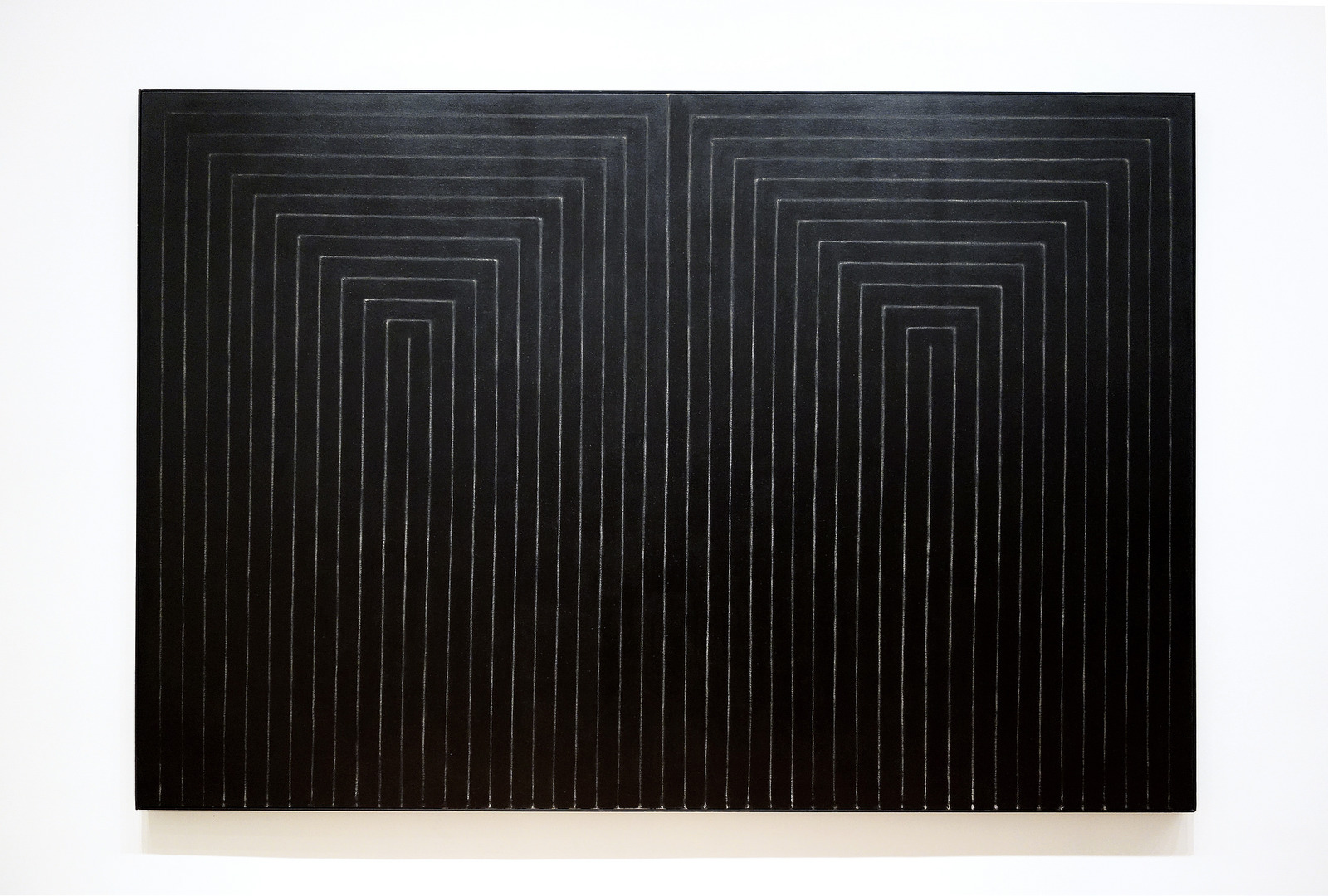
Frank Stella, The Marriage of Reason and Squalor, II, 1959, enamel on canvass, 230.5 x 337.2 cm (The Museum of Modernistic Fine art)
The best known American abstract painting of the 1950s was gestural and emotionally expressive (encounter beneath). This art, known as Abstruse Expressionism was just that. It was abstract, but more than to the indicate, it was subjective—it was near the feel and the very being of the artist. Frank Stella's early serial, the "Black Paintings" of 1958-1959 (below), was none of these things.The Marriage of Reason and Squalor 2, one of that series, is characterized by thick black lines painted to alternate repeatedly with thin "stripes" of exposed sheet—with no room for gesture. The series features an array of designs made by differently arranging these same elements in symmetrical rectilinear patterns.
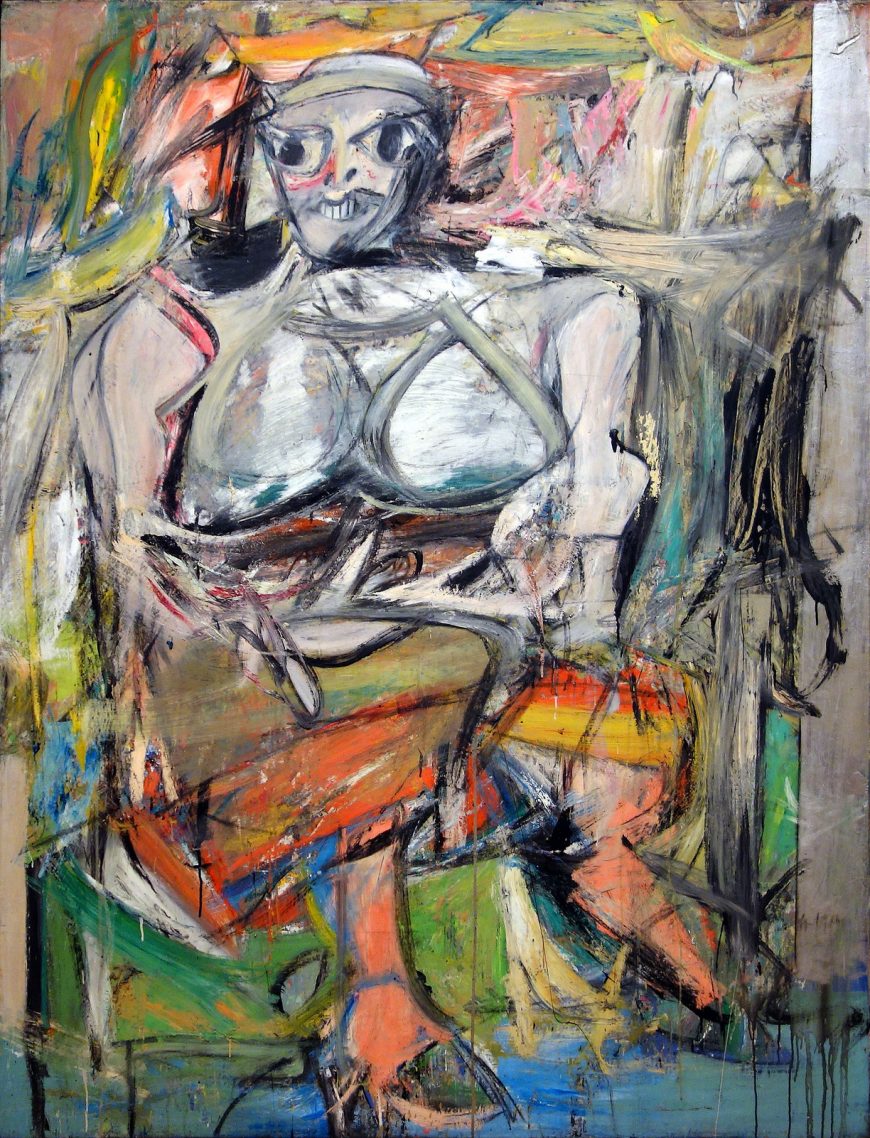
Willem de Kooning, Woman I, 1950-52, oil on canvas (MoMA)
Stella's early paintings are often associated with Minimalism which too begins at most this time. Similar the Minimalists, Stella heralds the literal presentation of spare abstract forms. His technical approach—constructing each stroke with a wide housepainter's brush and enamel house pigment—highlights the shift amid many artists of the fourth dimension to turn down the gestural style of activeness painting typical of Abstruse Expressionism, the preeminent American art motion of the 1950s. By dissimilarity, works like The Marriage of Reason and Squalor II exhibit a controlled sensibility that speaks to the systematic planning and conceptual framework that confute their simplistic appearance.
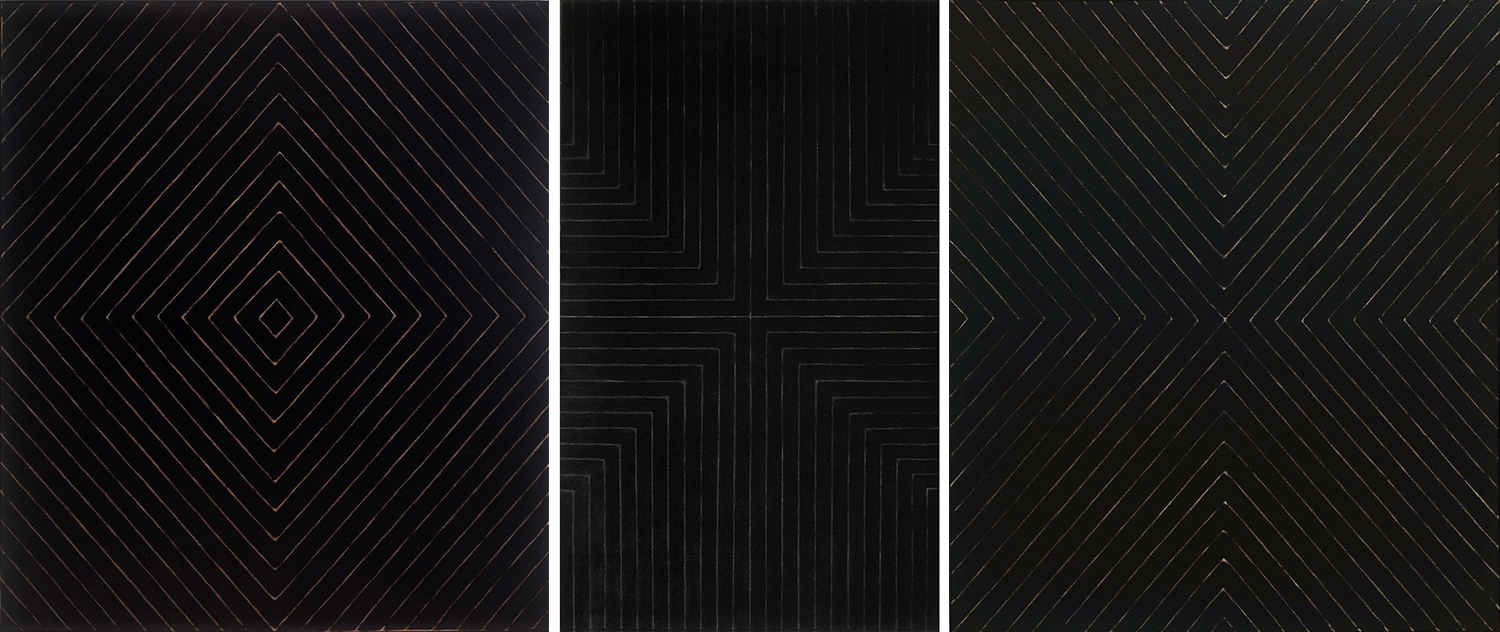
Selected Black Paintings (from left to correct): Frank Stella, Jill, 1959, enamel on canvas, 229.6 x 200 cm (Albright Knox Art Gallery); Frank Stella, Dice Fahne Hoch!, 1959, enamel on sail, 308.9 × 184.9 cm (Whitney Museum of American Art); Frank Stella, Zambezi, 1959, enamel on canvass, 230.51 x 200.03 cm (SFMOMA)
Rejecting emotion
Stella wanted to eliminate the personal reference and symbolic significant associated with modernist abstract painting. In this way, his paintings differ from those of European modernists similar Piet Mondrian who used reductive geometrical forms to communicate spiritual ideals. Stella criticized the work of these earlier painters as likewise "relational," a term he used to depict their subjective process of arranging singled-out parts in relation to 1 another in lodge to create what they saw as a harmonious and counterbalanced composition.ane
Jasper Johns was an important influence on Stella in these formative years. Working in the 1950s, Johns had also rejected the metaphysical overtones of Abstruse Expressionism in his ironic employ of encaustic, an ancient media that requires careful application to build up layers of wax and pigment, and reference to everyday objects. Johns' deliberate mark-making denied action painting's insistence on the spontaneity of individual expression, and his rendering of easily recognizable targets and flags mocked 1 of Abstract Expressionism's claims—to communicate universal meaning through archetypal images.
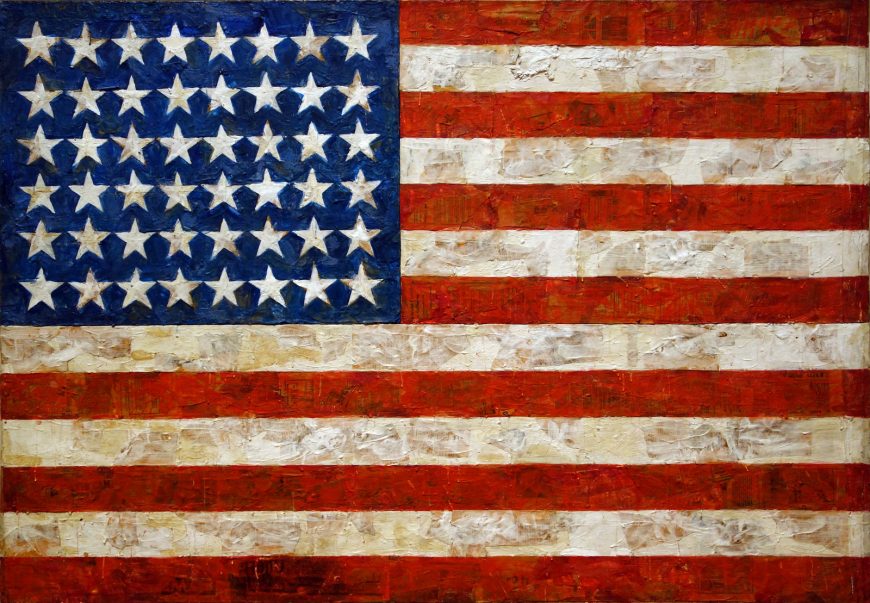
Jasper Johns, Flag, 1954-55 (dated on reverse 1954), encaustic, oil, and collage on fabric mounted on plywood, three panels, 107.3 10 153.8 cm (The Museum of Modern Art)
For Stella, Johns's fine art hinted at a way to eliminate the subjectivity inherent to the creative person's task. Representing an existing object meant that the appearance and construction of the thing itself adamant the painted imagery. Johns's apply of repetition further appealed for its visible adherence to the artist'south subject affair, and suggested to Stella a systematic, detached approach to artmaking based on a predetermined motif.
"What you run into is what you lot run across"
Stella adjusted these ideas for his ain non-objective imagery (images that don't depict recognizable forms) past looking to the rectangular shape of the canvas equally the basis for his compositions. He explained this rationale in 1960 to students at Pratt Institute in Brooklyn:
I had to exercise something about relational painting . . . . The obvious answer was symmetry—get in the same all over. The question still remained though, of how to practise this in depth. A symmetrical epitome or configuration symmetrically placed on an open up basis is non balanced out in the illusionistic infinite. The solution I arrived at . . . forces illusionistic space out of the painting at constant intervals past using a regulated pattern. The remaining problem was simply to detect a method of pigment application which followed and complemented the design solution. This was done by using the business firm painter'southward technique and tools.2
Although painted by mitt, the image's methodical regularity erased whatever sign of the artist's individuality or emotional investment in his work. In adopting "the firm painter's technique and tools," Stella replaced the romanticized notion of an artist's creative act with the actual labor used to make a painting. In this fashion, the Black Paintings challenged the assumption that a painting must represent an platonic or communicate profound pregnant to the viewer—a position summed up best in Stella'south famous quip, "What you encounter is what you see."
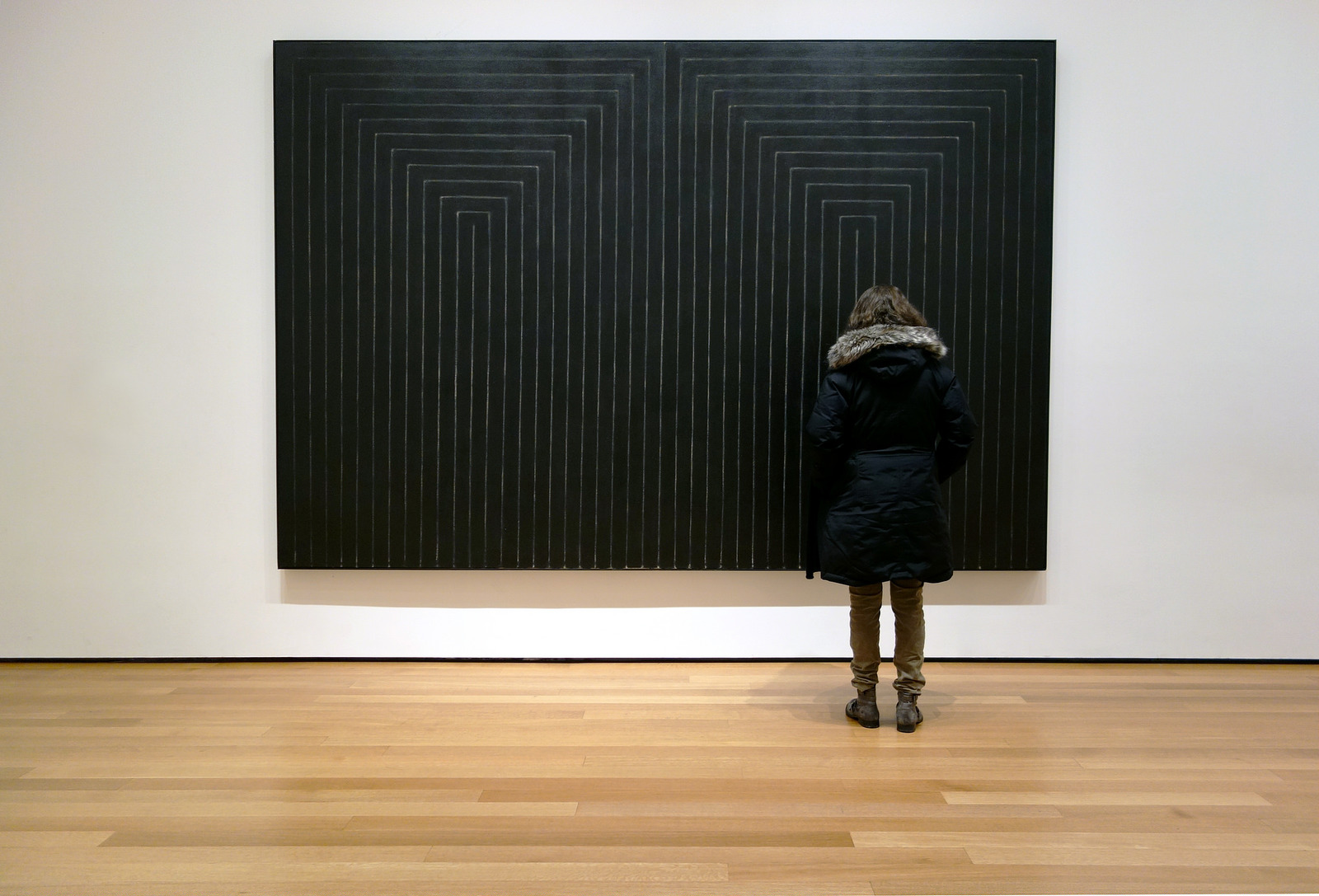
Gallery view: Frank Stella, The Union of Reason and Squalor, 2, 1959, enamel on canvass, 230.five ten 337.two cm (The Museum of Modern Art)
Stella's solution not only eliminated the subjectivity of abstruse painting, information technology likewise forced the viewer'south attending to the materials of the painting itself. Repeating the striped pattern to fill the canvas emphasized the flatness of the painted surface, an effect heightened past building up thick layers of dense blackness enamel to obscure brushstrokes and texture. The result was to deny the viewer the illusion of depth usually perceived in paintings, and to highlight the symmetrical blueprint that echoed the rectangular shape of the sail itself.
For artists similar Donald Judd, who too wanted to rid art of its metaphysical meaning and illusionistic tradition, Stella'southward Black Paintings appealed for their object-like advent. Stella used deep stretcher bars which caused his paintings to stand up out further from the wall. Judd, who is best known for his Minimalist sculpture, argued that Stella'south paintings emphasized the three-dimensionality of the painting as a real object that extended into the space of the gallery itself. Likewise, the man scale of the sheet seemed to heighten the art'south physical human relationship to the viewer, a characteristic of Minimalism in sculpture. Stella rejected these interpretations, however, insisting that his primary interest was the viewer's optical feel.
The championship
For all of Stella'south emphasis on painting's formal properties (that is how the painting looks equally opposed to what it represents), the provocative titles of his Black Paintings hogtie speculation about deeper significant. These includes Nazi references such every bit Arbeit Macht Frei and Die Fahne Hoch , and places such as Arundel Castle (a favorite subject of English Romantic painters). The general tendency of the titles to reflect what Stella called "'downbeat' and 'depressed political' situations" suggests they say more nigh the artist and the world around him than the paintings themselves.iii In the example of The Wedlock of Reason and Squalor II, Stella's orderly pairing of identical halves plays on the contrasting terms in the title. Information technology was Carl Andre, Stella'south long-fourth dimension friend and fellow artist, who first invented the title in 1957 for a series of his own pastel drawings that he destroyed. Considering both men agreed the phrase was an apt label of their lives equally artists in New York Metropolis, Andre suggested Stella use the championship for his painting.4

Frank Stella, The Marriage of Reason and Squalor, Two (detail), 1959, enamel on canvass, 230.five 10 337.2 cm (The Museum of Modernistic Fine art)
Art historian Caroline Jones believes The Marriage of Reason and Squalor 2 sums up contradictions that are pervasive throughout all the Black Paintings. She writes, "It is precisely the marriage of reason and squalor—the union of control and menses, the matings between differences, the pleasures of conjugation—that allows the procreation of significant in the Blackness Paintings (to pursue Andre's analogy.)"5 Noting that the painting was the second of two versions of the same composition, Jones shows that, despite Stella'southward mechanical opinion, close looking (see particular above) reveals tell-tale signs of the artist'southward hand: small drips of paint, blurred edges in the black lines, varying widths of the white space in between, and tonal shifts in the layers of color. She even points out how the overall configuration pulls ever so slightly to the right as evidence of Stella's dominant hand at piece of work.6
Like Pop Art, which developed around the aforementioned fourth dimension, Stella's Blackness Paintings challenge viewers by representing imagery that is self-evident and lacks expressive bear upon. For fine art historians like Jones, this detached arroyo to fine art making reflects the economic shift toward mass production and the growing article culture of the United States in the 1960s. Nevertheless, by asking usa to consider Stella's creative procedure and his motivations for and then strongly denying information technology, The Marriage of Reason and Squalor Ii besides forces us to treat the painting like a traditional work of art, enervating focused attention to its visual upshot and intellectual engagement with the conceptual issues information technology raises.
Notes:
1 Bruce Glaser, "Questions to Stella and Judd." Art News 65.v (1966), pp. 55-61.
2 Frank Stella, "The Pratt Lecture," reprinted in Brenda Richardson, Frank Stella: The Black Paintings (The Baltimore Museum of Art, 1976), p. 78.
3William Rubin, Frank Stella (NY: The Museum of Modernistic Art, 1970), quoted in Brenda Richardson, Frank Stella: The Blackness Paintings (The Baltimore Museum of Fine art, 1976), p. 3.
4 Richardson, 46.
five Caroline Jones, The Machine in the Studio (University of Chicago Press, 1996), p. 149.
6 Ibid., p. 148.
Additional resources:
This painting at MoMA
Frank Stella 1972, YouTube
Frank Stella, Black Serial I (Prints), National Gallery of Art
Cite this page as: Dr. Virginia B. Spivey, "Frank Stella, The Marriage of Reason and Squalor," in Smarthistory, September 10, 2016, accessed Apr 29, 2022, https://smarthistory.org/stella-marriage/.

Post a Comment for "The Marriage of Reason and Squalor Ii What Tools Did Frank Stella Use for Art"